
The fashion industry of 2026 has reached a definitive crossroads. The era of “disposable” clothing—defined by ultra-fast cycles and staggering landfill contributions—is facing a reckoning from both legislative mandates and a culturally transformed consumer base. With the implementation of the Circular Economy Act and the mandatory adoption of Digital Product Passports, the industry’s most prestigious title is no longer “Newest,” but “Most Meaningful.”
At the heart of this revolution is the Limited Edition Upcycled Capsule Collection. Once a niche hobby for independent crafters, upcycling has ascended to the pinnacle of luxury. In 2026, slow fashion lovers aren’t just looking for organic cotton; they are seeking “Waste-to-Wealth” stories—garments that represent design as a subversive action against the status quo.
The New Era of Circularity: Necessity as the Mother of Invention
In the 2026 context, “Limited Edition” has shed its artificial marketing veneer. In traditional retail, scarcity was manufactured to drive hype. In the upcycled world, scarcity is a mechanical reality. A designer cannot produce 10,000 units of a jacket if they only have 40 yards of a specific 1990s deadstock denim or 15 vintage silk scarves to work with.
This shift has birthed a new design philosophy: Radical Circularity. Designers are no longer starting with a sketch and ordering fabric; they are starting with the “scrap” and allowing the material to dictate the form. This is the ultimate expression of slow fashion—a system where production is tethered to the availability of existing resources rather than the extraction of new ones.
The Art of Upcycling vs. Recycling: Value Valorization
To appreciate the modern upcycled capsule, one must understand the difference between Recycling and Upcycling.
- Recycling (Downcycling): This process often involves breaking down textile fibers mechanically or chemically to create new yarn. While useful, it often results in a loss of fiber integrity and requires significant energy.
- Upcycling (Value Valorization): Upcycling maintains the “integrity” of the original material while adding value through design. It is the practice of “hacking” the waste stream. By taking a high-quality, discarded garment and transforming it into a contemporary silhouette, the designer is performing an act of Highest Value preservation.
In 2026, this is often referred to as “Design-Led Recovery.” The goal is to ensure that the intellectual and artistic labor added to the scrap makes the final piece more valuable than the original ever was.
The Anatomy of a 2026 Upcycled Capsule
Today’s slow fashion capsules are characterized by three core pillars: durability, gender-neutrality, and a “modular” aesthetic. Here are the essentials defining the current landscape:
1. Reworked Heritage Denim
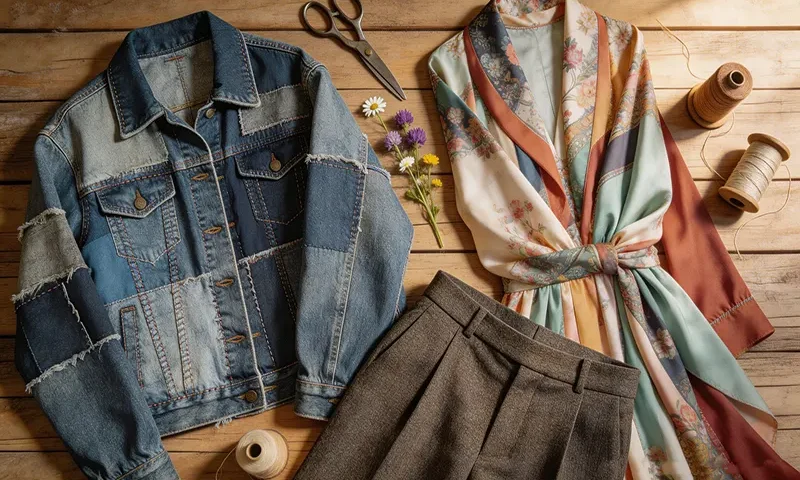
Denim remains the most upcycled textile due to its incredible longevity. 2026 collections focus on Japanese Sashiko (functional embroidery) and intricate patchwork. By combining various washes and weights from discarded vintage jeans, designers create “Infinite Denim”—pieces that are stronger and more visually complex than factory-fresh alternatives.
2. Deadstock Luxury Silk & Tencel
Independent labels are increasingly “hacking” the waste of major luxury houses. These capsules utilize “deadstock”—the leftover fabric bolts from high-end runway productions that would otherwise be incinerated. These collections prioritize fluid silhouettes—oversized shirts and wrap skirts that are ageless and gender-fluid, ensuring they can be passed between friends and family regardless of size or gender identity.
3. Modular Industrial Accessories
We are seeing a surge in “Hardware Upcycling.” Handbags and utility vests are being crafted from discarded automotive upholstery, seatbelts, and even tech components. The focus here is on repairability; these pieces are designed with visible screws or modular clips, allowing the owner to swap out parts rather than replacing the entire item.
Verification and the Digital Product Passport (DPP)
One of the greatest challenges of upcycling was historically the “Trust Gap.” How could a consumer be sure of the material’s origin?
The 2026 Digital Product Passport has solved this. Every garment in a high-end upcycled capsule now features a discreet QR code or NFC chip. When scanned, the owner can view the “Story of the Scrap”:
- The Origin: Where the base material was sourced (e.g., “Post-industrial deadstock from an Italian silk mill”).
- The Journey: The carbon footprint of the rework process.
- The Artisan: A profile of the individual who hand-cut and stitched the piece.
This transparency has turned the garment into a piece of Verifiable Art, making it a secure investment for the slow fashion curator.
The “30-Wear Test” and Maintenance
Slow fashion isn’t just about the purchase; it’s about the stewardship. A hallmark of the 2026 capsule is that it is built to pass the “30-Wear Test”—a cultural standard where a consumer commits to wearing a piece at least thirty times to offset its initial production impact.
Slow Fashion Maintenance Guide
- Cold-Water Wash: Preserve fiber strength and reduce energy by 90%.
- Spot Cleaning: The “Uniform” mindset encourages cleaning only where necessary.
- Visible Mending: In 2026, a “flaw” is an opportunity. Use contrasting thread to celebrate the repair.
- Cost-per-Wear Calculation: Evaluate a garment’s value by dividing its price by the number of years you intend to keep it.
From Consumer to Curator
The rise of limited edition upcycled capsules signals the end of the “Passive Consumer.” In 2026, the slow fashion lover is a Curator. They aren’t looking for a trend; they are looking for a story. They understand that a garment with a past life has a soul that a mass-produced item can never replicate.
As we move toward a truly circular future, the “New” is no longer the standard for luxury. In the eyes of the slow fashion movement, the most prestigious garment in the room is the one that was saved from the shadows, hacked by a creative mind, and given a second chance to be extraordinary. The future of fashion isn’t found in a factory—it’s found in the beautiful, deliberate reimagining of what we already have.

