
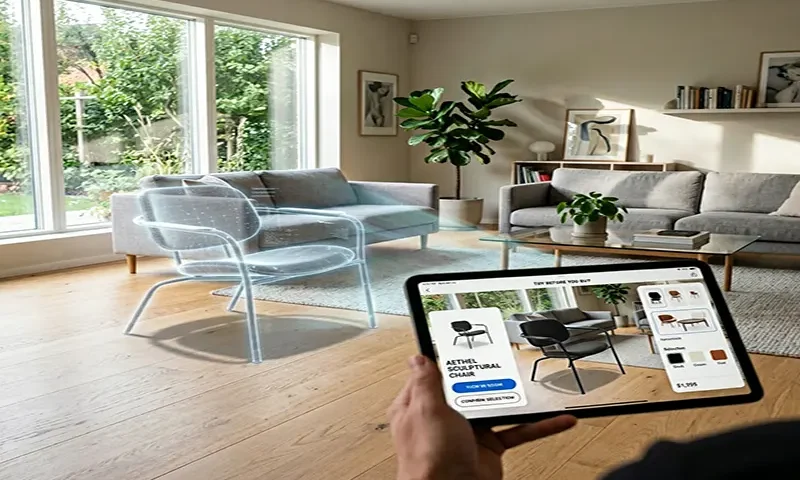
For decades, the most significant barrier to purchasing high-end interior design online was “spatial anxiety.” While a two-dimensional photograph can capture the color of a fabric or the curve of a silhouette, it fails to communicate the visual volume of a piece within a specific environment. This is especially true for sculptural furniture—avant-garde, organic, and often oversized pieces that act as functional art.
In 2026, Augmented Reality (AR) has moved beyond being a marketing gimmick to become a high-fidelity “Try-Before-You-Buy” (TBYB) infrastructure. By bridging the gap between the digital showroom and the physical living room, AR is revolutionizing how we interact with, validate, and purchase the objects that define our homes.
The End of Spatial Guesswork
The “return loop” has long been the Achilles’ heel of the furniture industry. A stunning, three-legged stone coffee table might look perfect in a curated studio photo, but once it arrives in a 400-square-foot apartment, it can easily overwhelm the room or disrupt the foot traffic.
AR eliminates this guesswork by creating a Digital Twin of the furniture. In 2026, these digital models are no longer low-polygon representations; they are photorealistic assets that utilize Physically Based Rendering (PBR). This means the digital “velvet” on an AR sofa has the same light-absorbency and sheen as the real material, and the “grain” on a sculptural oak chair aligns perfectly with the physical version.
The Tech Behind the Lens: Why 2026 is Different
The seamlessness of modern AR furniture shopping is driven by three key technological pillars that have matured significantly over the last few years.
1. LiDAR and Surface Intelligence
Modern mobile devices now utilize high-grade LiDAR (Light Detection and Ranging) to create a real-time mesh of the user’s room. This allows for millimeter-accurate scaling. When you place a 7-foot sculptural floor lamp in your room via AR, it is exactly 7 feet tall in the digital space, allowing you to see if it will clear your ceiling or clash with existing shelving.
2. Environmental Light Estimation
One of the “tells” of old AR was that the digital object looked like it was floating. Today’s AR uses Light Estimation Technology to analyze the actual light sources in your room. If you have a warm lamp on the left and a window on the right, the AR furniture will cast shadows and show highlights that match those specific light sources, making the object look truly “anchored” to the floor.
3. People and Object Occlusion
The most impressive breakthrough is Occlusion. In the past, if you walked in front of an AR chair, the chair would appear to sit “on top” of you. Now, spatial computing allows the device to recognize depth. You can walk behind your AR sculptural sofa, or place it behind a physical plant, and the digital object will be hidden accordingly. This allows users to test “spatial flow”—the ability to move around a piece—before committing to the purchase.
Why Sculptural Furniture Needs AR
Sculptural furniture—characterized by non-linear shapes, asymmetrical balances, and biophilic influences—is notoriously difficult to visualize. Unlike a standard rectangular bookshelf, sculptural pieces change dramatically depending on the viewing angle.
- 360-Degree Evaluation: A sculptural lounge chair might have a stunning profile but a bulky back. AR allows a user to “walk the piece” as if they were in a gallery in Milan.
- Biophilic Integration: Many modern sculptural pieces are designed to bring “nature-inspired” forms indoors. AR helps users place these “organic” shapes in a way that complements the natural light and architectural “bones” of their home.
- The ‘Vibe’ Check: AR allows for instantaneous style experimentation. You can “swap” a brutalist concrete side table for a fluid, 3D-printed resin stool in seconds to see which better fits the “energy” of your existing decor.
The Impact on the Global Design Industry
The shift to AR TBYB is not just a win for the consumer; it is a fundamental shift in the economics of design.
Sustainability and the ‘Return-Loop’
The environmental cost of shipping, unboxing, and returning a 200-pound stone table because it “didn’t fit the vibe” is immense. By increasing “Fit Confidence” to nearly 100%, AR is drastically reducing the carbon footprint associated with furniture returns.
The Democratic Showroom
AR has leveled the playing field for boutique designers. A small-scale artisan in a remote studio can now compete with global giants. As long as they provide a high-quality USDZ or glTF 3D file, their sculptural work can be “placed” in a luxury penthouse in London or a farmhouse in Oregon, bypassing the need for expensive physical showroom space.
Pro-Tips for AR Placement
For the most accurate “Try-Before-You-Buy” experience, follow these steps:
- Clear the Stage: Move any clutter or small objects from the area where you plan to “place” the furniture to help the sensors map the floor.
- Natural Lighting: Perform your AR scan during the day. Natural light helps the AI better estimate shadows and texture depth.
- Check the ‘Bones’: Use the AR “tape measure” tool to double-check the clearance of doorways and hallways—the furniture might fit the room, but you still need to get it through the door!
- Capture and Compare: Take screenshots of the AR piece from multiple angles and compare them at different times of the day to see how the “mood” of the piece shifts with the sun.
The Future is Spatial
We are moving toward a world where the distinction between “online shopping” and “in-person browsing” is becoming irrelevant. AR has turned the home into a living canvas where we can audition the world’s most beautiful sculptural furniture in real-time.
As spatial computing becomes more integrated into our daily devices, the fear of making a “bold” design choice is evaporating. AR gives us the confidence to choose the avant-garde, the oversized, and the unconventional. The future of home decor is no longer about looking at a screen; it is about looking through it to see the potential of our spaces, one photorealistic, sculptural masterpiece at a time.