
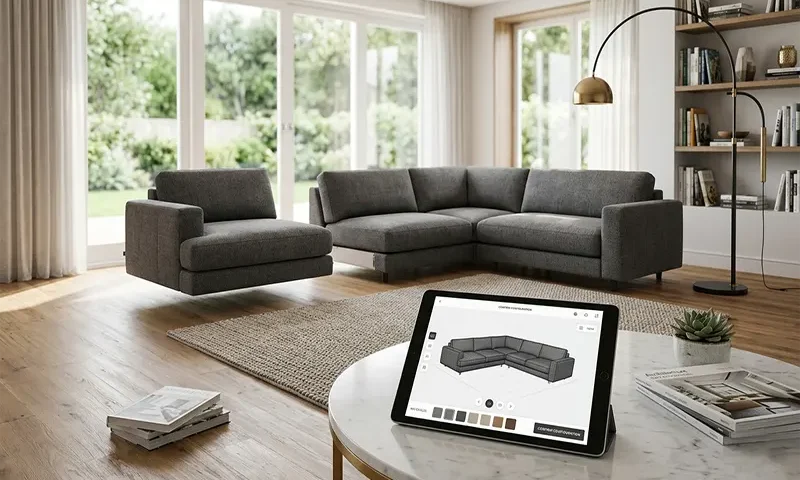
The era of crossing your fingers and hoping the sofa fits is officially over. For decades, buying a couch was a high-stakes gamble involving measuring tapes, paper floor plans, and a significant amount of spatial guesswork. However, the intersection of high-end furniture design and advanced web-based rendering has birthed a new gold standard: Modular Sectional Sofas paired with 3D Configuration Tools.
This shift represents more than just a convenience; it is a fundamental change in how we inhabit our homes. As living spaces become more multi-functional, the furniture within them must be equally adaptable. By utilizing 3D tools, consumers are no longer just shoppers—they are designers.
The Rise of the Modular Sectional: Fluidity for Modern Life
The traditional “fixed” sofa is a relic of a time when people stayed in one home for thirty years. Today’s homeowner or renter values mobility and evolution. Modular sectionals consist of individual “blocks” or modules—corners, armless chairs, ottomans, and chaises—that can be rearranged, added to, or subtracted from as life changes.
Why Modularity is Winning
- Adaptability: A modular sofa can start as a three-seater in a small apartment and grow into a sprawling U-shaped pit in a suburban living room.
- Ease of Transport: Moving a massive, one-piece Chesterfield up a narrow staircase is a nightmare. Moving five individual modules is a breeze.
- Customization: You choose the exact orientation that fits your “flow,” whether you need a left-facing chaise for window views or a double-sided island for an open-concept loft.
The Power of 3D Configuration Tools: Closing the Confidence Gap
The primary barrier to buying furniture online has always been the “Confidence Gap”—the psychological hesitation caused by not being able to touch, sit on, or visualize a product in a personal space. 3D Configuration Tools solve this by providing a digital twin of the product that responds to user input in real-time.
Real-Time Rendering and 360-Degree Views
Unlike static images, a 3D configurator allows you to rotate the sofa on every axis. You can inspect the stitching on the back of a module or see exactly how a velvet fabric reflects light compared to a matte linen. This level of transparency builds trust between the brand and the consumer.
The End of “Will It Fit?”
Advanced configurators now integrate Dynamic Dimensioning. As you drag and drop a new ottoman or corner piece into your virtual build, the tool updates the total width and depth measurements instantly. This eliminates the risk of ordering a piece that blocks a doorway or overlaps a fireplace hearth.
Key Benefits for the Modern Consumer
Using an online configurator isn’t just about the “cool factor”; it provides several practical advantages that save time and money.
1. Space Optimization
Most living rooms have “quirks”—radiators, floor vents, or asymmetrical corners. A 3D tool allows you to build a sectional that hugs the perimeter of your room perfectly, maximizing seating capacity without sacrificing floor space.
2. Visual Accuracy and Material Testing
Colors on a screen can be deceiving. However, modern 3D engines use PBR (Physically Based Rendering) to simulate how different textiles react to light. When you switch from “Charcoal Performance Fabric” to “Cognac Top-Grain Leather,” the tool adjusts the highlights, shadows, and textures to give you the most realistic preview possible.
3. Interactive Interior Design
There is a psychological satisfaction in the “creative play” aspect of these tools. It allows users to experiment with bold choices—like a contrasting color for a single module—without the fear of making an expensive mistake.
Must-Have Features for Modular Sectionals
When exploring online configurators, look for these specific features to ensure you are getting a high-quality piece of furniture:
- Hidden Connection Systems: Look for “alligator clips” or magnetic connectors that keep modules from sliding apart on hardwood floors.
- Performance Fabrics: Since modular sofas are meant for “living,” ensure the tool offers stain-resistant and pet-friendly options.
- Kiln-Dried Hardwood Frames: The beauty is on the outside, but the longevity is in the frame.
- Reversible Cushions: This doubles the lifespan of your sofa by allowing you to flip them to even out wear.
What to Look for in a High-End Configuration Tool
Not all digital tools are created equal. If you are looking for a seamless experience, the software should offer:
- Mobile Responsiveness: You should be able to design your sofa on a tablet or phone while standing in your actual living room.
- Augmented Reality (AR) Integration: The “View in Room” feature is the ultimate tool. It uses your phone’s camera to overlay your 3D design onto your actual floor, allowing you to walk around the virtual sofa to check for scale and clearance.
- Instant Quote Generation: As you add modules or upgrade fabrics, the price should update transparently so you can design within your budget.
The Human Element: Beyond the Screen
While 3D tools are revolutionary, they work best when paired with traditional shopping wisdom. Even the most advanced 4K rendering cannot tell you exactly how a fabric feels against your skin.
Pro Tip: Always use the 3D tool to finalize your layout and scale, but order physical fabric swatches before hitting the “buy” button. Seeing the color in your home’s specific lighting (which changes from morning to night) is the final step in foolproof furniture shopping.
The Future of the Living Room
The marriage of modular sectional sofas and 3D configuration tools represents the ultimate empowerment of the consumer. We are moving away from a world of “standard sizes” and toward a world of “bespoke solutions” accessible to everyone with an internet connection.
By leveraging these tools, you aren’t just buying a place to sit; you are engineering a foundational piece of your home that can evolve alongside you. Whether you are moving into your first “adult” apartment or redesigning a family sanctuary, the ability to build, rotate, and visualize your perfect sectional in 3D ensures that your vision and your reality are one and the same.

