
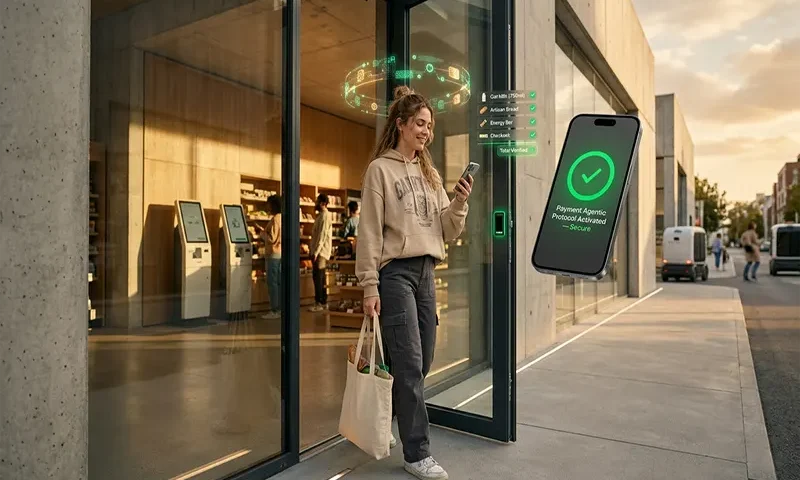
In the fintech landscape of 2026, we are witnessing the transition from “Conversational Commerce” to “Agentic Commerce.” For years, AI served as a sophisticated recommendation engine—a digital shop assistant that curated lists for human approval. Today, the paradigm has shifted toward Agentic AI: autonomous systems capable of reasoning, planning, and executing complex workflows without constant human intervention.
The most critical friction point in this evolution is the financial transaction. For an AI to truly shop on behalf of a human or an enterprise, it requires more than just an algorithm; it requires a Financial Identity and a secure, programmable payment protocol. Integrating these protocols is the final step in realizing the “Zero-Friction Economy.”
The Shift from Assistant to Agent: The Autonomous Mandate
Traditional e-commerce relies on the “Click-to-Pay” model, where a human must authenticate every transaction through a GUI (Graphical User Interface). Agentic AI bypasses the GUI entirely, interacting directly with merchant APIs.
In 2026, an agent isn’t just looking for “a pair of running shoes.” It is analyzing the user’s past biomechanical data, cross-referencing upcoming weather patterns in their travel calendar, and evaluating real-time inventory levels across multiple global vendors. To move from “recommendation” to “acquisition,” the agent must be empowered to move value across the network.
The Architecture of AI Payment Protocols
To allow a machine to pay a machine (M2M), the underlying architecture must solve for three things: Identity, Authority, and Security.
1. Managed Identity and Self-Sovereign Credentials
An AI agent cannot hold a traditional bank account in the human sense. Instead, it utilizes Managed Identities or Self-Sovereign Identities (SSI). These are cryptographically verifiable credentials that prove the agent is authorized by a specific “Principal” (a person or a corporation). When an agent initiates a payment, it presents a tokenized proof of identity that links it to a regulated financial anchor.
2. Programmable Money and Smart Contracts
Autonomous shopping relies on Smart Contracts—self-executing code that triggers a payment only when specific conditions are met (e.g., “Pay upon proof of shipment” or “Pay only if the price is under $50”). By using programmable money—often in the form of stablecoins or Central Bank Digital Currencies (CBDCs)—the payment becomes part of the logic of the purchase itself, rather than a separate, manual step.
3. Threshold Signatures and MPC
Security is the paramount concern. To prevent a compromised agent from draining a user’s funds, modern protocols use Multi-Party Computation (MPC) and Threshold Signatures. The private key required to authorize a payment is never held in its entirety by the AI agent. Instead, it is “split” between the agent, the user’s secure enclave, and perhaps a third-party risk-management server. A transaction is only signed if a “threshold” of these parties agrees, effectively creating a real-time, automated multi-sig process.
The Autonomous Shopping Lifecycle: A 2026 Workflow
How does this look in practice? Consider a high-performance enterprise environment or a sophisticated smart home.
Step 1: Inventory Awareness and Need Identification
The agent operates in the background. A smart manufacturing facility’s AI detects that a specific bearing in a robotic arm is showing vibrational patterns indicating 90% wear. It doesn’t alert the manager; it initiates a procurement agent.
Step 2: Agentic Negotiation
The “Buyer Agent” reaches out to several “Seller Agents.” This is not a simple price-scraping exercise. The agents engage in millisecond negotiation. The Buyer Agent might offer a faster payment settlement or a bulk-buy commitment in exchange for a 5% discount. This is a machine-to-machine dialogue where terms are optimized in real-time based on the Principal’s predefined strategy.
Step 3: Atomic Settlement
Once terms are agreed upon, the payment protocol executes an Atomic Swap. The payment is locked in an escrow-like smart contract and released the moment the shipping carrier’s API confirms the item has been picked up. There is no invoicing, no 30-day wait, and no manual credit card entry.
Governance, Ethics, and “The Kill Switch”
Giving an AI a wallet naturally raises questions of liability and control. If an agent buys the wrong part, who is responsible?
Granular Permissions and Spending Limits
Integration protocols must include a “Governance Layer.” Users set Dynamic Spending Limits. For example, an agent may have “Auto-Approve” status for purchases under $500, but require a biometric “Human-in-the-Loop” (HITL) approval for anything higher. Furthermore, permissions can be category-specific; an agent may be authorized to buy office supplies but blocked from purchasing luxury goods.
The Liability Gap
In 2026, the industry is moving toward a “Principal-Agent” legal framework. As long as the agent operates within the bounds of its encoded permissions, the human Principal is liable. However, if the agent’s logic fails due to a provider’s bug, the liability shifts to the AI developer. This necessitates Autonomous Transaction Insurance, a new fintech product that protects against “algorithmic errors” in shopping.
Protocol Security Checklist for Enterprises
- Identity Verification: Is the agent using a non-custodial, verifiable managed identity?
- Ephemeral Wallets: Does the agent use single-use “burner” tokens for high-risk transactions?
- Real-Time Auditing: Is every autonomous transaction recorded on an immutable ledger for 24/7 compliance?
- The Kill Switch: Is there a global override that can freeze all agentic financial activity in one click?
The Zero-Friction Economy
Integrating agentic AI payment protocols is about more than just convenience; it is about economic velocity. By removing the human bottleneck from the transaction loop, businesses and households can operate with unprecedented efficiency.
We are moving toward a world where “shopping” is no longer an activity we perform, but a background service that happens to us. As agentic AI begins to hold the “purse strings” of the digital world, the protocols we build today will become the bedrock of a new, autonomous global marketplace. In this Zero-Friction Economy, the value will not be in the act of buying, but in the strategic parameters we set for the machines that buy for us. The future of commerce is silent, invisible, and entirely autonomous.

